The Seen
Footnote: 1Auguste Rodin on Life, Love, and the Soul of ArtIn short, Beauty is everywhere. It is not that she is lacking to our eye, but our eyes which fail to perceive her. 1
— Auguste Rodin (1840 - 1917)
I first encountered this quote from the French sculptor Auguste Rodin during my junior year of high school. At the time, the idea struck me deeply, though I didn't truly understand it.
Its meaning only began to unfold later, as I became more attentive to everyday life. I started seeing it everywhere: the golden light pouring into a quiet café, the visible devotion between a pet and its owner, or the eyes of parents looking at their child with love. In these simple, ordinary moments, I finally began to feel what Rodin meant.
Beauty is neither rare nor hidden; it surrounds us constantly. What is missing is not beauty itself, but our willingness to pause, to notice, and to feel. Beauty is everywhere—we just have to open our eyes and our hearts to see it.
#Beauty
When I noticed how much beauty exists in my daily life, I became eager to dive into the art world more deeply. I wanted to immerse myself more in the atmosphere of Art, so I started visiting art museums on random weekends. I actually love the silence that Art brings to me. I can feel the beauty of the pieces and the atmosphere of the museum even if I don't quite understand the full meaning or history of the work. But what I know is this: with Art, I feel more like myself, and more aware of the world around me. I feel more alive and more connected to the world.
#Art Museum
The art museum is a special place for me. It is a sanctuary where I can slow down and be present with the artwork. The quiet halls and the careful curation create an atmosphere that encourages contemplation and connection. The blank space around the paintings allows me to focus more fully on the artwork itself, without distraction. It creates a sense of openness that invites me to engage with the piece on a deeper level. The emptiness doesn't feel empty at all. Instead, it creates space within me — space to think, to feel, and to respond in my own way.
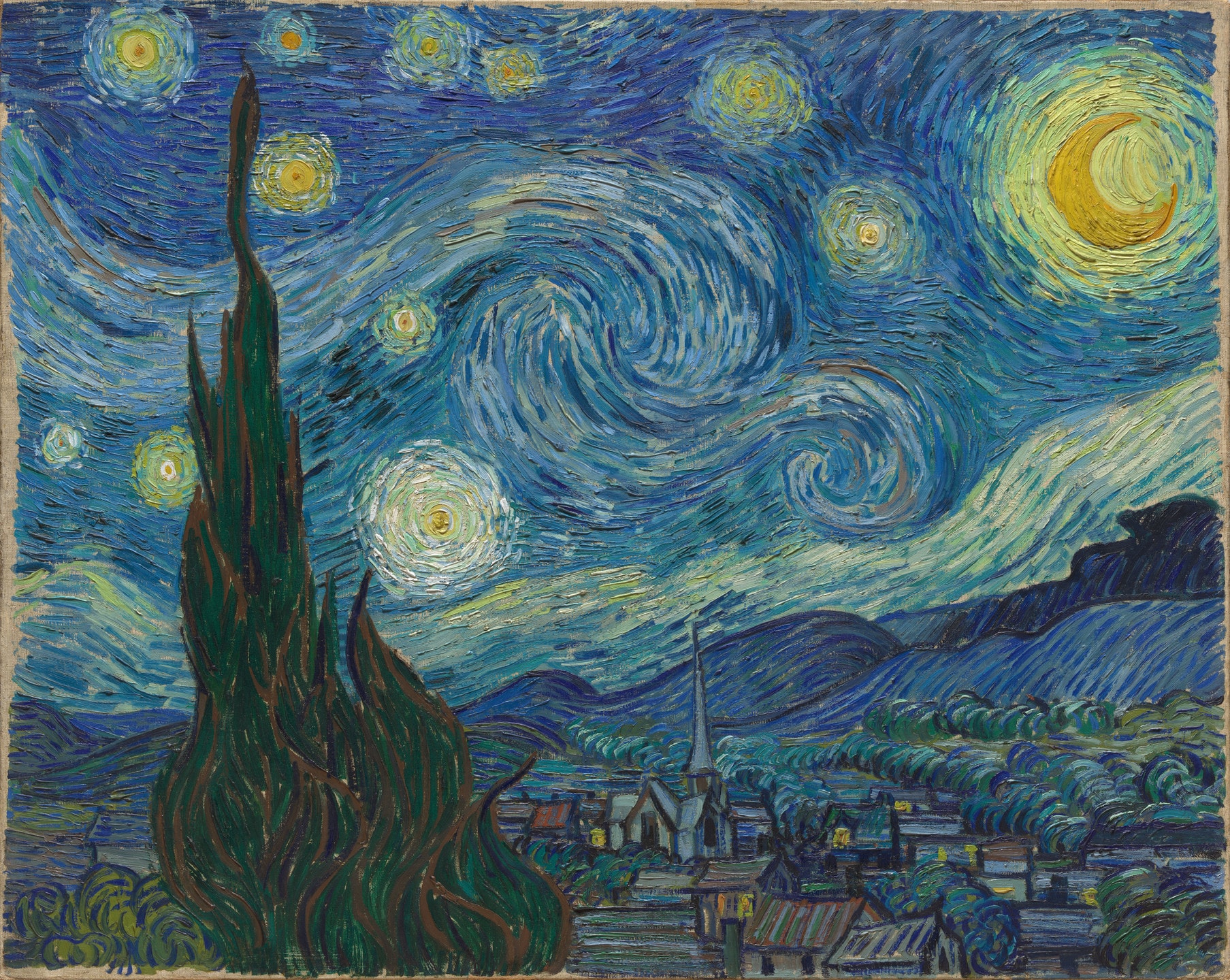
Vincent van Gogh
1853-1890
The Starry Night
1889
Oil on canvas
The Museum of Modern Art, New York
Acquired through the Lillie P. Bliss Bequest, 1941
When I look at the descriptions next to the artworks, I realize that they are designed with aesthetics in mind. The titles are larger, and there is ample margin around the text, creating a sense of space and allowing the reader to focus on the content. The paragraphs are well-organized, making it easier for the reader to follow along and understand the artist's intent. It's interesting how the layout of the text itself can enhance the reading experience, much like how code is formatted to improve readability. Both are designed with the reader in mind, aiming to facilitate understanding and connection with the content.
Portraits in Wartime
In the late 1930s and '40s, Europe was torn apart by war. Though some artists secured passage to leave the continent, others lived through the upheaval and destruction. This gallery brings together examples of portraits by those who stayed behind, including Joan Miró and Pablo Picasso. The works evidence how these artists transformed the traditional genre of portraiture as they reflected on the anxieties of wartime.
Paintings by Miró and the other artists in this gallery offered a vision of the future during a time of turmoil. In 1941 art historian James Johnson Sweeney wrote that Miró's work “belongs to the youth of a period that is opening, rather than the old age of a closing one.”
Organized by Ann Temkin with Rachel Remick
#AI World
In this fast-paced world, where AI is rapidly advancing and everything seems to be accelerating, beauty is a medium that allows me to slow down. It requires time and effort to truly feel it, and I need to create a flow state where I won't be interrupted in order to fully experience it. That's why I want to surround myself with beautiful things in my life, and even create more beauty, because that gives me more opportunities to feel it. Just like with my website 1chooo.com, I want to create a space where people can slow down and feel beauty, a place where beauty can be experienced rather than just seen.
This is, I think, what Rodin was pointing to. Beauty doesn't announce itself. It requires proximity — the willingness to stop, to be still, to look long enough for the painting to begin looking back at you.
Art Is Not What You See — It's What You Feel.